Monday, 12 September 2011

Cuenca

Cuenca is a beautiful colonial town sitting at 2500 meters in the south of the country.
We spent 3 days here in preparation to our departure to the Galapagos and we are really glad we did so as this town of half million people really enchanted us.
The pace is just right: people are friendly but at the same time they get on with their business and this is why this is probably one of the wealthiest towns we have seen so far.
For example, today we took 2 pair of jeans (Pelileo purchases) to a very busy shop (sastreria)for leg reduction. 20 minutes later they were ready and fitting perfectly. That cost in total £2.

Cuenca's architecture is enchanting. At every corner you either see a beautiful colonial building or a church.
We think that to describe this town pictures will do a better job than words.

Cuenca Cathedral
(rear)

(front from the main square)


(inside)

Some colonial buildings
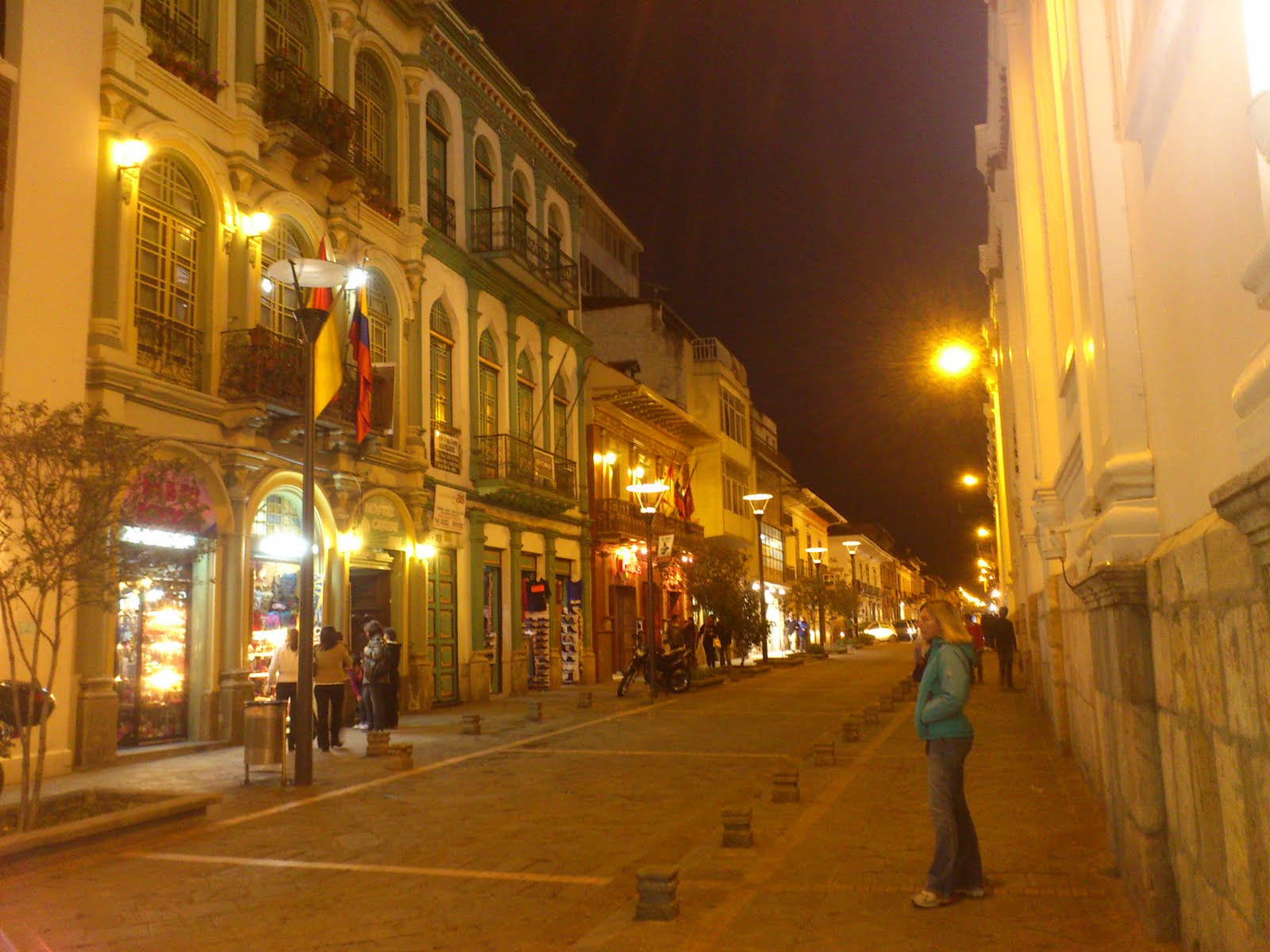
Cuenca by night

Colorful market
...................................................................................................................................................................
On our second day of sightseeing, as we approach 4pm we sit down on a bench in a little square near the church of San Sebastian.

A dog, a mix of a poodle and basset is chasing pigeons, the temperature is perfect, the sun is just coming out from the clouds and kids are playing football beside the church marking the goals with their jumpers (old school!) and making up rules as and when.
We probably watch them playing for over 1 hr, completely unattended by anybody and we compare this scene with London where kids are taken by their parents to expensive football schools for the privilege of kicking a ball for a little while.
..........Maybe they got it right here in Cuenca, we think.


To top up a great weekend we were also lucky enough (thank you trip advisor!) to find the best accommodation and the best restaurant ever.


For $60 per night we slept at the Casa Ordonez, a fabulous hotel decorated in colonial style right in the centre of town.
Picture of one of the sitting rooms with fire place and an old grammophone

Our room is perfect and fresh roses are brought in every morning.
5 minutes walk from the hotel we also find the “Tiestos” restaurant.
This is probably one of the best restaurants we have ever tried, not only in South America.


Food service atmosphere and life music are spot on but the chef/owner (Juan Solano) is just a league of his own.
Joan with Elena


With a full restaurant (always fully booked) not only he managed to carve a little space for us (at the table that was reserved to the russian ambassador) but he even came to our table to show us which sauces would go with which food, mixed them, cleaned the prawns heads for us, and if only we let him, he would have mouth fed us.
Some of the food we tried


Sunday, 11 September 2011

La nariz del Diablo (a chapter for bikers out there)

It takes around 6 hours on a bus from Banos in the central highlands to Cuenca in the southern highlands. On a motorcycle it would have taken probably less than 4 hours if it wasn’t for all the breaks we took to enjoy the sceneries.

What can I say: what a road!
Let’s start in the right order though.

We already know about the Banos-Ambato.
From Ambato to Rio Bamba its 60 kms of boring road with old buses and trucks expelling black diesel fumes in your face......well, Ok, you have the 6300 meters volcano Chimborazo on the right side to look at.

It is just after Rio Bamba that everything changes again.

For some strange reason the road has no traffic whatsoever; you find yourself back at around 3000 meters with cultivated hills and a river running in parallel to your road.

Then, as you climb further up the cultivated hills disappear, living space to uncultivated paramo and a couple of lagunas.


The road begins its descent after Guamote.

Black clouds are hiding the top of the mountains on the right side, but luckily the sky above us is clear, no rain, just the chill of the altitude.

We turned a corner and the altipiano immediately leaves space to a canyon: it’s the so called Nariz del Diablo (devil’s nostril).

The road is pretty much in perfect condition, if not for a small land slide around a corner.

We reach the town of Alausi where, according to all travel guides, we should jump on a train that climbs down the cliff on a zigzag trajectory.

We obviously stick to the bike and we are glad we do so. The road goes up first just to dive down to the river after. But it is not over. Crossed a small bridge over the river it is now time to climb back up at the other side of the canyon on what it looks like a very steep road.

From time to time we dive into small clouds sitting in the middle of the road, just to come out with our visors covered in drizzle.

We drive through few more villages until we reach the small village of Biblian. This village, at 2900 would be unimpressive if it wasn’t for the beautiful Santuario de la Virgin del Rocio, a castle like church sitting on top of a hill.
At Azogues is where the fun ends. We are now back to a modern 3 lines road that takes us straight to the town of Cuenca.

It’s 4 pm when we hit town and we finally realise that we were so absorbed with our route that we completely forgot to have lunch.

Banos

We left our hotel in Latacunga on Monday morning with the intention to pay one last visit to the welder that saved the day.
Unfortunately when we turned up nobody was at home, and we were only able to take a picture of the yard where the works had been carried out.

With the bike perfectly functioning, getting to Banos is a piece of cake.
These are 2 pictures of the central stand perfectly welded and lateral stand straight again


The road is fast and pleasant. When we turn left from Ambato on the A30 we begin our descent from 2800 down to 1800. The temperature begins to rise (finally) and the nature around changes rapidly, with green forests and waterfalls appearing in the valley formed by the river Pastaza.
Yes, we left a volcano (The Cotopaxi) with a white top behind us, but a new one is also welcoming us (Tungurahua), and this one, not only is very close to town but has only stopped being active 3 years ago.

We base ourselves just 2 kms outside town at the “casa verde”, the most eco friendly hotel in the area. Our room not only offers spectacular views of the valley and the river but it also has a hammock on the balcony....it just doesn’t get any better than this.
Elena checking mails on the Hammock
Views from our balcony
We really enjoyed our conversations with Douglas, the Aussie owner of Casa Verde.
Only 5 years ago Douglas and his wife bought this piece of land for 30K. According to the law in Ecuador all you need is to invest $30,000 in the country and you automatically acquire permanent residency, and that really simplifies things when it comes to investing/moving abroad.

The other appealing factor for Douglas was the currency. He reckons that investing in South America can be fairly dangerous since currencies over here tend to have a fairly consistent history of devaluation. In Ecuador, since the currency is the US dollar, this risk is partially reduced.

Casa Verde has been functioning and accepting guests for over 3 years, and yet it is not completely finished (in particular the outside looks very bare)

The interiors however are very stylish and I have to admit that our jaws dropped when we discovered that Douglas built the whole place pretty much by himself.

We are told that this is what you learn in Australian schools. I would gladly swap my 5 years of Latin studies for this!

Banos essentially offers 3 things: good food, relaxation (with its numerous SPAs) and adventure (with agencies offering all sort of activities from climbing, canopying, rafting etc).

In 5 days we obviously tried them all. In our opinion the highlights were the meals at the Cafe Marianne for exquisite French cuisine with a fireplace and great music, and rafting on the Pastaza river.

Thanks to the German twins this time we managed to paddle with perfect synchronisation.


Sadly we were not too impressed with the SPAs we tried. Their enthusiasm was not enough to compensate the lack of skills. Shame because we were really hoping to get a bit of a treat after our tough days in the Cotopaxi region.
On a positive note we really enjoyed our day trip to Pelileo, a small village 30 km north of Banos. 60% of the population here is dedicated to the production and sale of jeans. The whole town is filled with shops selling jeans of all brands or no brands at all. Prices vary from £3 for a cheap pair to £8 for the expensive ones........yes, of course we did pile up and now the bike is few Kgs heavier!
In the picture a pile of jeans in the streets of Pelileo

Sunday, 4 September 2011

Cotopaxi and Latacunga: 3 very tough days

We left Quito heading south towards the Cotopaxi National Park.
Cotopaxi is a 5800 meters active volcano which has been very destructive over the centuries.
In its last eruption in 1877 completely destroyed the town of Latacunga and the dust went as far as Colombia.
The entrance of the national park is at km 43 and it not very easy to spot. The road is in fact all gravel.
10 meters from the left turn the road goes up hill quite steeply. At the top of this mini hill, before becoming level, there is also a train rail which is sticking out from the ground.
I immediately spotted the danger and asked Elena to get off the bike in order to cross the train rail.
The centre of the bike is quite low, this is due to the weight (380kgs when fully loaded with bags and passengers) and with the central stand pointing down.
Any time we drive over speed bumps for example we can feel the stand scratching the bump, and an exposed train rail positioned uphill does not look easy to cross.
And in fact the lateral stand hit the metal rail quite heavily to the point that it completely bent by 90 degrees.

I did manage to keep the bike up but the damage was done.
We found accommodation 200 meters from the entrance at the Huagra Corral hotel.
The hotel is very nice and people extremely friendly but unfortunately they do not have central heating nor hot water.
Elena got sick the following day therefore I went to climb the Cotopaxi alone with our guide.
In 3 days we never managed to get a clear picture of the volcano as the weather was bad with clouds, snow and strong wind.
This is the best picture we could take on day one at our arrival.


When you climb Cotopaxi you have 2 options:
You can drive on a jeep up to 4000 meters and then climb half way up to the chalet at 4810 meters or you can climb to the chalet on day one, slip until midnight and then climb the remaining 1000 meters of glaciers over night.
I clearly opted for option 1 as Elena was not well at the hotel and also because I didn't have the necessary gear to walk on a glacier (and these are my excuses).
The climb to the chalet is not easy, in particular if it's snowing and the wind is blowing in your face.
I was lucky enough to have brought with me my thermal bike balaclava and the guide gave me some walking sticks.
The 2 Argentinean tourists that we picked up on the jeep while crossing the national park gave up pretty much immediately as they did not have the necessary gear and they were also carrying heavy bags.

This is a picture of my guide walking in front

Some hostile terrain


And finally reaching the chalet


Inside the chalet I was very happy for 2 reasons: I was finally warming up drinking hot chocolate and I was very proud to notice that the chalet was empty as we were the only 2 people that had made it that morning.


Happiness soon disappeared when I asked for the toilet and I was told it was outside. The bog was completely filled till the top with a solid block of yellow ice....... not nice!!!!

As the weather was slightly improving it was time to begin our descent, not without taking one last picture though!


During our descent the clouds opened up slightly finally revealing a spectacular landscape

Driving back we gave a final look at the volcano still covered in clouds behind us


Back at the hotel Elena was still unwell.
We decided to stick around for 1 more day just to see whether she would recover enough to drive at least to Latacunga (40 kms away).
It was a catch 22. Staying in that freezing hotel wasn't good for her, but driving on a bike wasn't good either.
The following morning as there was no sign of improvement, we opted to leave.
I checked the bike before putting all the luggage on and I noticed that the central stand was a bit unstable. On a closer look it appeared that also the central stand had been damaged by the impact and in actual fact it was now so bent that was dangerously touching the bike's chain.
I could not drive with the full stand up so Elena had to keep her foot on the stand to keep it low enough not to touch the chain and high enough not to touch the ground.
She did a great job. We covered our 40 kms in this fashion and when we finally arrived in town I dropped Elena at the hotel and went looking for  a mechanic.
The first mechanic I found told me that "frankly the bike was too much for him and he did not have the skills to help!".
I asked another biker on the road who pointed me to a bigger shop.
The shop keeper took a look at the problem.
Unfortunately the issue was worse than originally prospected. The central stand wasn't bent. The metal plank holding the stand was actually cracked in 3 points.
The mechanic told me he could not help as the iron needed to be put back into the original shape and welded and he did not have the right tools.
He eventually pointed me in the right direction.
The person who finally helped me wasn't in fact a mechanic at all. He was a professional welder.
In his "shop" you could find all sort of metal products and parts but certainly not motorcycles.
And yet this man looked at the problem and started working on it straight away.
For the second time on this trip I regretted I did not have with me my camera or phone to take pictures or videos.
For 2 and half hours this small Andean man fought against German technology using his hands hammer and a scalpel (and of course a welder in the end).
I think he won hands down.
No need to say that a little crowd had also formed around us watching the show unravelling in this courtyard.
When it came to pay the bill he shyly asked for £6......
Let's say we both left each other with a big smile on our face.

Back at the hotel, around 4 pm with empty stomach I asked for Elena's room.
They told me they didn't have a guest with that name. The only single woman in the hotel was an American tourist called Jessica.
For a moment I did feel like a squeeze in my stomach; all sort of potential horrible scenarios went through my head; luckly even this last issue was soon resolved.
it was only a misunderstanding.
Elena was safe asleep in room 11.



La Mitad del Mundo

Quito lies only few kms south of the equators.
In actual fact in the natives language Quito means middle of the Earth.
For 50 cents we got a bus that took us to La mitad del mundo, a fairly big tourist centre where you can see the monument showing the exact location of the Equator.


To be perfectly honest we were not too impressed about this site as with the exception of the monolith and the equatorial line did not offer anything interesting to see.

Luckily, next door you can find the Intinan museum.
This is a much more interesting site and the 2 hrs guided tour is really worth taking.

They also claim to be located exactly on the equator, and at least they make every possible effort to prove it with experiments such as balancing eggs on a nail, showing clockwise and anticlockwise release of water from the sink etc

To be on the safe side we also took a picture on this second equator:

Elena was particularly happy to find out that you also lose weight  at the equator without the need of diet or exercise

Now,  if you are light hearted, look away.
At the museum they showed us an interesting ritual performed by the natives of the Amazon region.
The warriors used to decapitate important prisoners, but not only that, they would remove the skull from the face, boil the now empty skin with a special mix of plants that would reduce the head to the size of a fist.

Following is the process of mummification illustrated:


The now mummified mini head would be used as decoration or even worn as pendulum around the neck.

This is a real mini head, 160 years old, perfectly preserved


Only seconds from viewing the mini head I was lucky enough to capture a flying colibri grabbing some seeds from a plate nearby.


Quito

The capital of Ecuador welcomed us at 2900 meters.
For the riders out there I can say that it is quite easy to find directions in town.
The shape of the town is in fact long and thin, since it is sitting on a altipiano surrounded by volcanoes and mountains.
There are 4 main roads that run from north to south:
La sucre (avenida Occidental) on the right side
L'avenida 6 de decembre, on the left side
And the 2 main arteries the 10th of August and Avenida America running in parallel in the centre.
You are never too far from any of these 4 roads: you can't get lost.

This is the view of Quito North from "El Panecillo"

The old centre can be visited in 1 day and it is full of beautiful buildings and churches.


This is the church of "compania del Jesus" just around the corner from the main square and next to the main Cathedral.
Talking of which there are 2 frescoes in the main cathedral that attracted our attention:
The last supper, where Christ and the disciples are eating guinea pigs and drinking chicha, instead of the usual lamb and wine.
And the nativity where a llama has miraculously found its way to Nazareth.....


Wherever you are in the centre you can always spot El Panecillo in the distance.
El Panecillo is a "sugar loaf" hill in the middle of town topped by a statue of the Virgin Mary with wings.
We are told it is the only statue of the Virgin Mary with wings in the world.
Walking up the hill is tough and most importantly dangerous, since the area is very dodgy.
You are better off in taking a taxi....let the taxi driver rip you off instead!!!

A close up picture of the Virgin Mary with wings

In the far east corner of the town you will be able to visit la "Capilla del'hombre", a museum designed and built by 20th century most prestigious Ecuadorean artist: Oswaldo Guayasamin.
Guayasamín's images capture the political oppression, racism, poverty, and class division found in much of South America and part of the world.

This picture is called Los Mutilados.
It is made of 6 panels that can be moved and turned in more than 12 million different combinations and they will always produce a meaningful picture. It took the artist 7 years to paint.


Next door is the Fondation Guayasamin where it is possible to buy original paintings of the artist for as little as $300. We were seriously tempted to splash out, unfortunately it is not easy to carry a painting on a bike and therefore we renounced.
At the fondation are also exhibited 4 paintings called los culpables, probably some of our favourites of the artist.


Moving to the far west of town you will find the gates for the "teleferiqo".
This cable lift will take you almost on top of the volcano Pichincha at 4100 meters for amazing views of Quito.
We were obviously well equipped with wind/water proof jackets, alpaca jumpers, hat and scarves.
With us in the cable cabin was a young Russian chap, only dressed with jeans and a light shirt.
He also asked us to point him in the right direction to the 4 hrs hike to climb to the top.
He was either very brave or from Siberia. We wished him luck.

Views of Quito from Cruz Loma at 4100 meters.


Saturday, 3 September 2011

Otavalo market

Saturday morning is market day in Otavalo and this has been the case for hundreds of years.
Not that any other day of the week there is no market in the streets of Otavalo. It is only that on Saturday the whole town becomes a huge market.

Most of the streets in the city centre are closed to the traffic and stalls selling all sorts of things appear everywhere.

The real deal in our opinion is however happening just outside town, next to the “stadium”.

This is where the animal market takes place.

You need to be there quite early in the morning to see all the action.

If you do, please do not follow my steps. In fact I thought I would save some time by skipping breakfast and grabbing and eating something at the market.....well, let’s put it this way, the smell around is not exactly conducive to eating....

Beside the negotiation we really enjoyed seeing people (man women kids) leaving the market with their purchases under their arms, and I mean chicken, goats, pigs, cows, all alive and screaming.


If you are interested in buying livestock in Otavalo more or less these are the ongoing prices, or at least what we understood:

Big Pig = $200
Piglet = $50

Pair of hens (apparently they only sell in pairs) = $9

Guinea pig  (local delicacy) = starting at $5, but you can negotiate down to $4

Sorry, we could not grasp the price of cows and goats.....
Ah, by the way, did anyone see my rooster?


After all that morning action, if you still have energy you might want to get on the bus and for 25 cents go10 km outside town and relax at the laguna San Pablo for a nice meal and a tour on a boat.